
Planned or unplanned? It sounds almost too straightforward to be so important. But understanding when a purchase decision is actually made is one of the most important things you can know about a category, and one of the most commonly overlooked. Because (sorry) teams often don’t actually know the answer in objective, quantified terms.
Key Takeaways
- Where the decision happens is where your money should go — planned and unplanned categories demand completely different strategies and budgets.
- In-store spend can be wasted on planned categories — if shoppers arrive with their minds made up, the real influence window was before the trip.
- Unplanned categories are won or lost in the aisle — placement, visibility, and promotions aren’t decoration, they’re the entire conversation.
- Benchmarking turns observation into investment decisions — seeing how your category compares to others is what makes the right budget allocation hard to argue with.
Table of Contents
- What Do We Actually Mean by Planned and Unplanned?
- Why Planned Categories Demand a Different Strategy
- Why Unplanned Categories Are Won and Lost in the Aisle
- What Our Data Actually Measures
- Simple Concept, Real Consequences
Some of the most valuable concepts in shopper research are the ones that sound almost too simple to bother with. This is one of them. Whether a category is planned or unplanned sits at the very heart of how we think about purchase triggers at Shopper Intelligence, and in our experience, it’s something that far too many category plans treat as background noise rather than a front-and-center strategic question.
Get it right, and your marketing investment goes where it works hardest to change behavior. Get it wrong, and you can spend a significant budget in entirely the wrong place, at entirely the wrong moment, talking to a shopper whose mind was already made up before they walked through the door.
What Do We Actually Mean by Planned and Unplanned?
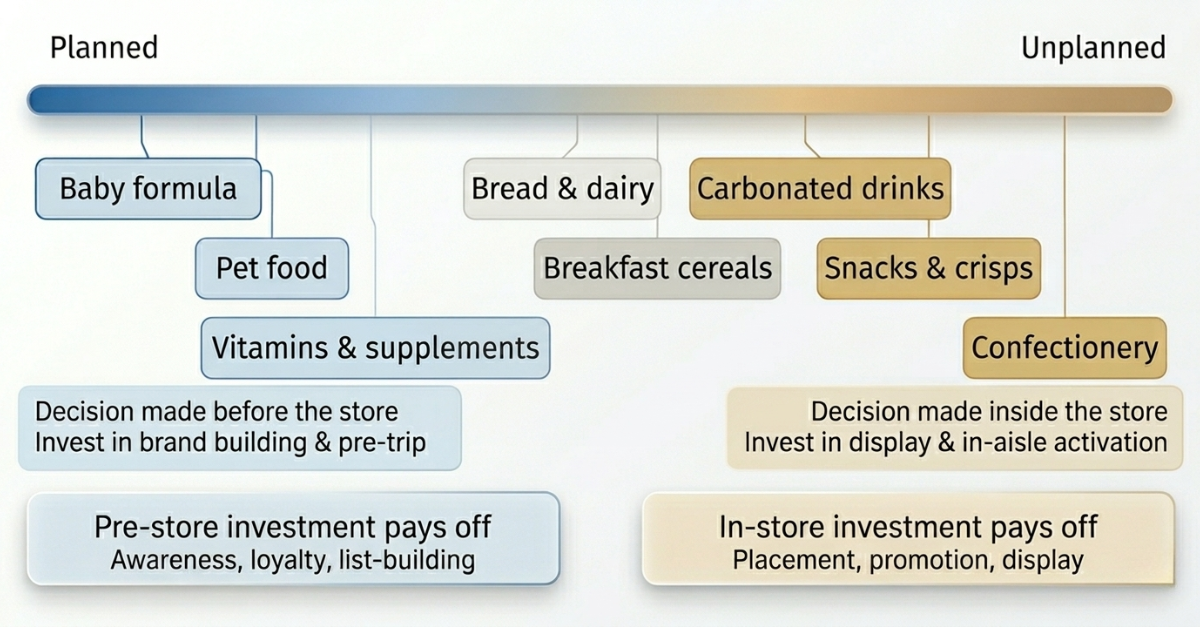
Planned
The decision was made before the store
The shopper arrived ready to buy. Much of the thinking happened at home, online, or earlier in the week. Your influence window was before the trip, not during it.
Unplanned
The decision was made inside the store
The shopper had no intention to buy until something changed their mind in the moment. Promotions, displays, and in-aisle triggers are where the real work happens.
Where the majority of decisions are made is exactly where you need to be investing. And those two places require very different strategies, budgets, and measures of success.
Why Planned Categories Demand a Different Strategy
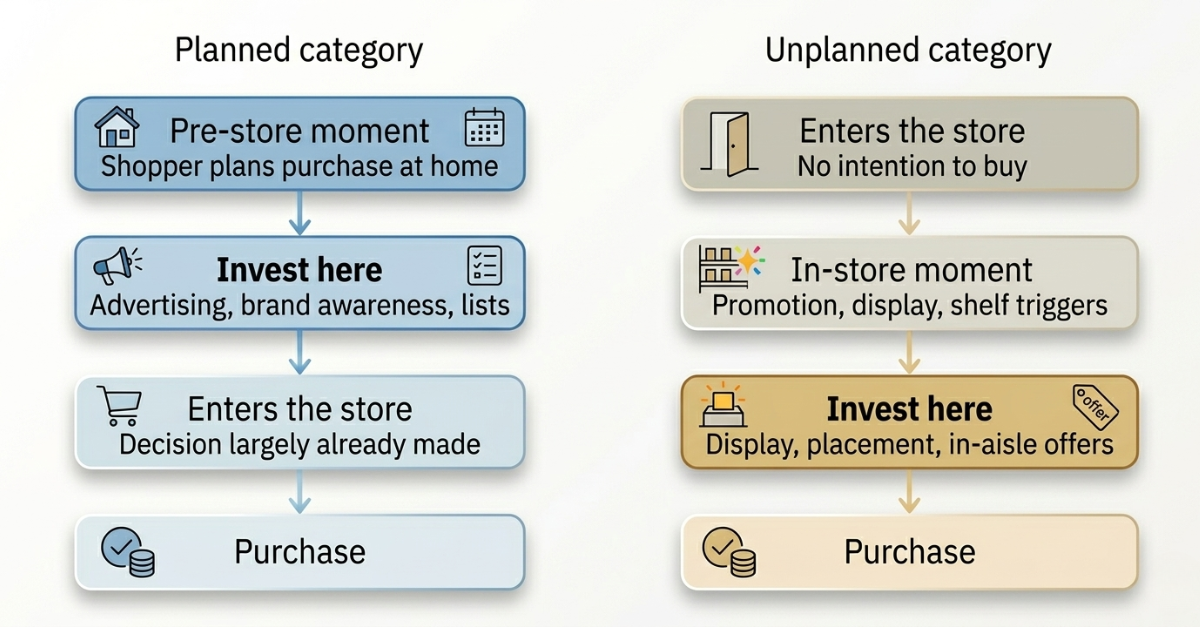
In a heavily planned category, shoppers arrive with their decision largely made. The scope to influence them in the aisle is limited, so much has already been settled. The bigger opportunity is earlier in the journey: building brand awareness, getting into the consideration set before the trip begins, being present when the shopper is deciding what goes on the list.
If your category is predominantly planned and you’re spending heavily on in-store display and point-of-sale, it’s worth asking honestly how much of that is influencing a decision that was already made. Could some of it be redirected? That’s a tough call and one that needs objective data behind it, not just intuition.
Why Unplanned Categories Are Won and Lost in the Aisle
An unplanned category operates on completely different logic. The shopper didn’t come in looking for you, which means in-store presence and activation are everything. A promotion that goes unnoticed, a display in the wrong location, a shelf that’s hard to navigate. These quietly cost you purchases that were there to be won.
Worth remembering
In unplanned categories, most decisions are made inside the store. Every element of the in-store experience — placement, visibility, promotion, display — is part of the conversation. None of it is just decoration.
What Our Data Actually Measures
Our research asks shoppers directly about where their purchase decision was made and what triggered it. We look at motivation before the store, what was driving the intention to buy before the trip began and at what happened inside the store that created or confirmed the purchase.
We then go deeper into the specific triggers. What was the shopper thinking about before they arrived? Was a promotion the deciding factor in-store? Was it a display? Was it simply seeing the product on the shelf? Understanding the weight of each of these influences tells you a great deal about where the real levers are in any given category.
And crucially, by benchmarking categories against each other or by benchmarking brands or shopper segments, we can show clearly how different investment allocations perform relative to one another. That’s where the practical value sits. Not just knowing that a category is planned but being able to see what that means for how you should be spending your budget compared to a category next door in the same aisle.
Benchmarking is what turns a simple observation into a clear direction for an investment decision. When you can see how one category compares to another on purchase planning, the right allocation of your marketing budget becomes much harder to argue with.
Simple Concept, Real Consequences
Planned versus unplanned is one of those ideas people nod at and don’t apply with any rigor. It gets acknowledged in category reviews and quietly ignored in the marketing plan, partly because, without the metrics, it stays abstract.
The consequences are predictable. Budget goes to in-store activity where the shopper’s mind is already made up. Pre-store investment gets underweighted where the decision window is early. Across a full portfolio, those mistakes add up to meaningful wasted spend.
The fix starts with knowing, for each category you manage, how planned it is and making that a genuine input to investment decisions rather than a data point that sits in an appendix.
And one final point. Slicing our data by this key “planning” criteria will show you a vast treasure trove of insights about what makes the planned shopper different to the unplanned. Often, we see different demographics, different missions and different attitudes. So not only do you know where to focus your spend, you know how to focus it too.
If you’d like to see how your categories stack up on purchase planning and what that means for where your shopper marketing should be focused, we’d be glad to walk you through what our data shows.